
Why Are ETA, ETD, ATD, and ATA So Important in Maritime Logistics?
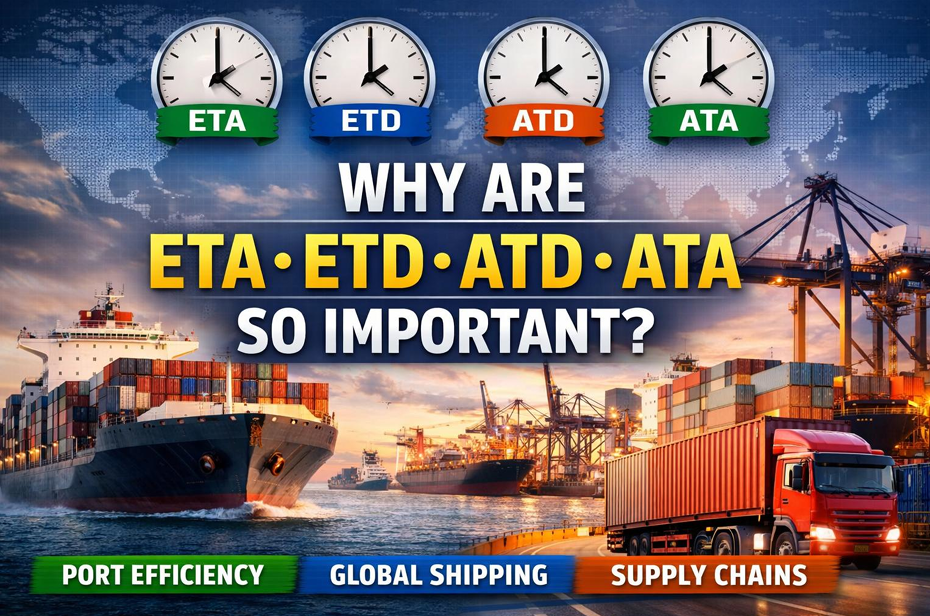
In the maritime and logistics industry, ETA (Estimated Time of Arrival), ETD (Estimated Time of Departure), ATD (Actual Time of Departure), and ATA (Actual Time of Arrival) are not just operational terms — they are the backbone of global supply chain coordination.
In today’s world of global trade, increasing vessel sizes, port congestion, and just-in-time inventory systems, precise timing is more critical than ever. Even a small inaccuracy can create a ripple effect that impacts ports, shipping lines, freight forwarders, customs brokers, truckers, warehouses — and ultimately the final customer.
1️⃣ Ports & Terminal Operators
Ports operate like highly synchronized ecosystems. A small timing error can cause major congestion and operational inefficiencies.
When ETA and ETD are inaccurate:
- Berth planning becomes inefficient
- Yard space allocation becomes chaotic
- Equipment (cranes, RTGs, terminal trucks) cannot be optimally deployed
- Truck queues increase outside the port
- Demurrage and detention costs rise
When accurate ETA/ETD data is available:
✔ Berth windows are scheduled efficiently
✔ Labor, cranes, and yard space are properly allocated
✔ Port congestion is reduced
✔ Truck traffic is streamlined
✔ Vessel turnaround time improves
✔ CO₂ emissions decrease due to reduced idle time
In competitive global hubs, ports that leverage real-time and predictive ETA systems gain a significant operational advantage.
2️⃣ Shipping Lines & Vessel Operators
With globalization and growing trade volumes, vessel traffic has increased dramatically. Ships are larger, routes are more complex, and congestion is more common.
A vessel may arrive on schedule, but if berth availability is delayed due to inaccurate arrival data from other vessels, it may:
- Wait at anchorage for days
- Burn additional fuel
- Disrupt its entire sailing schedule
- Cause delays at subsequent ports
Accurate ETA and ETD enable:
✔ Better voyage planning
✔ Fuel optimization (including slow steaming strategies)
✔ Reduced waiting time at anchorage
✔ Improved schedule reliability
✔ Stronger coordination with ports
Today, schedule reliability is a key competitive factor. Customers expect transparency and predictability.
3️⃣ Freight Forwarders & Logistics Companies
For logistics providers especially in dynamic trade hubs like the UAE — accurate timing directly impacts:
- Customs clearance planning
- Truck scheduling
- Warehouse coordination
- Delivery appointments
- Client satisfaction
When ETA changes without timely updates:
- Clearance teams may prepare too early or too late
- Trucks may be booked unnecessarily
- Storage costs increase
- Delivery commitments may be missed
With real-time ATA and ATD:
✔ Clients are proactively informed
✔ Transport plans are adjusted efficiently
✔ Service reliability is maintained
✔ Operational costs are controlled
Accurate data empowers logistics companies to move from reactive operations to proactive supply chain management.
4️⃣ Consignees & Beneficial Cargo Owners (BCOs)
For importers and manufacturers, cargo timing directly affects:
- Production schedules
- Retail inventory levels
- Construction timelines
- E-commerce delivery promises
Many businesses operate under Just-in-Time (JIT) systems to minimize holding costs.
If ETA is inaccurate:
- Production may stop due to missing materials
- Retail shelves may run empty
- Projects may be delayed
- Financial losses increase
This is why many BCOs are willing to pay a premium for reliable scheduling and full shipment visibility.
They demand:
✔ Real-time cargo tracking
✔ Predictable delivery windows
✔ Minimal supply chain disruption
5️⃣ Environmental & Sustainability Impact
Accurate ETA and ETD data also contribute directly to sustainability goals.
When timing is precise:
- Vessels optimize speed to match berth availability
- Anchorage waiting time decreases
- Fuel consumption is reduced
- CO₂ emissions decline
- Port congestion lowers
In an era focused on ESG performance and carbon reduction, precise maritime timing plays a measurable role in environmental responsibility.
6️⃣ The Domino Effect of Inaccuracy
One incorrect ETA can trigger a chain reaction:
- Port congestion
- Missed berth windows
- Delayed cargo discharge
- Trucking delays
- Warehouse backlogs
- Customer dissatisfaction
- Financial penalties
The global supply chain is deeply interconnected. A single timing error at sea can impact businesses thousands of kilometers away.
7️⃣ The Future: Real-Time & Predictive Data
The maritime industry is rapidly evolving toward:
- Real-time vessel tracking
- AI-based predictive ETAs
- Port Community Systems (PCS)
- Digital data exchange between stakeholders
- Integrated supply chain visibility platforms
To remain competitive, shipping and logistics companies must invest in technologies that provide:
✔ Accurate ETA & ETD forecasting
✔ Instant ATA & ATD updates
✔ Transparent communication
✔ Data-driven decision-making
Final Thought
ETA, ETD, ATD, and ATA are more than timestamps — they are strategic control points within the global supply chain.
Precision in maritime timing is no longer optional. It is a competitive necessity.